There was a moment during a visit in early February that stayed with me, one of those quiet shifts in perspective that makes you pause and think, "I hadn't thought of it that way before."
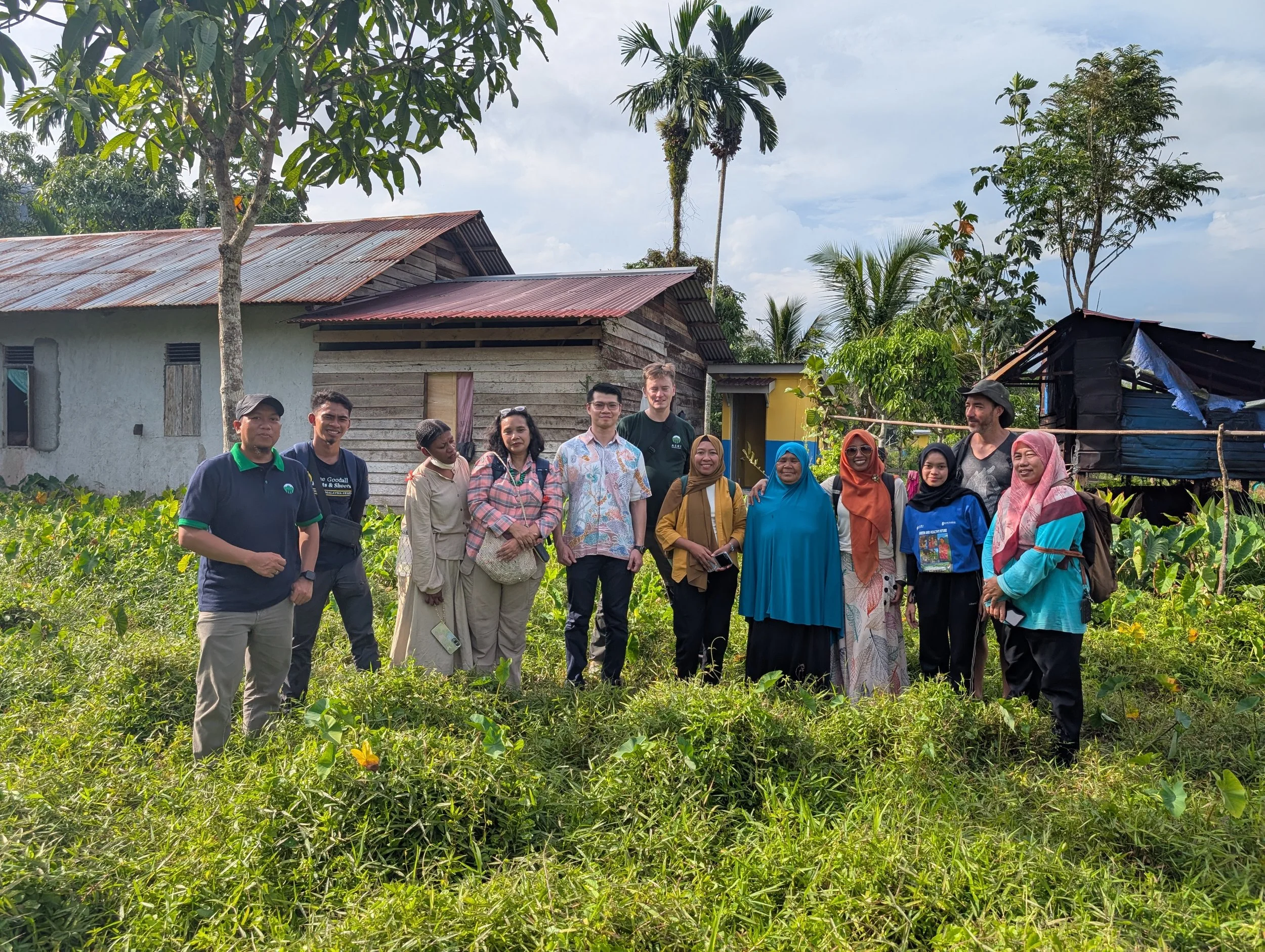
We were hosting a small group at ASRI: colleagues from Mana Impact, A Little Wild from Malaysia, BUMMA from Bogor and their partners from Papua, and Pai Seedlings from Thailand. The visit came through Imaginal Seeds, who brought together a small group of organizations they support which I think is a rare and generous gift of time, connection, and mutual learning.
In one of our indoor sessions, we shared openly about something many of us are navigating—financial sustainability as an NGO. We spoke about what ASRI has tried: running a clinic that serves thousands of patients, yet requires subsidies to operate; building an optical unit that has just begun to sustain itself; selling merchandise that contributes, but only marginally; exploring digital products that may or may not find their audience. And receiving paid visits, perhaps the most meaningful source of unrestricted income we have so far, yet still small compared to the scale of what it takes to run our programs.
Altogether, these non-grant sources make up only around 10% of our income. The reality is clear: we remain deeply dependent on grants.
I shared this as a reflection of where we are. In a world where "financial sustainability" is often emphasized, we are still learning what that truly means in practice and how far it can realistically take us.
It was in that space of openness that Damien Masselis, the Co-Founder and President of Pai Seedlings Foundation, Thailand, raised an important question.
Why are NGOs expected to also become businesses? He agreed that there is value in building business models that encourage financial independence, but his contention was this: it places organizations like ours in a situation where we need to compete with other companies on the business side — same markets, same rules — whilst those companies don't need to compete with us on the ethical framework: human, social, environmental.
And there is something more. A lot of our restoration work, Damien pointed out, consists in internalizing costs that businesses have externalized onto society. We take in their social-environmental costs, and yet are still expected to be competitive on the market side.
Is this fair? Is this realistic? Is this really supporting the causes we fight for?
Since then, I’ve been reminded of a reflection by Rahayu Oktaviani, founder of Kiara Foundation, who wrote about the quiet frustration of conservationists today. That their work is no longer primarily in forests, with wildlife, or alongside communities—but increasingly in writing reports, securing funding, and worrying about whether their teams’ contracts can continue.
I felt that deeply.
Because behind every conservation effort, every health service, every restored forest, there are people. People who need stability, clarity, and a sense of security to do their work well. And yet, much of our time as leaders is spent ensuring that the work can continue at all. That funding will come in. That contracts can be extended. That the team can keep going.
One-year grants, while appreciated, often leave us navigating uncertainty. They make it difficult to offer the very stability that long-term impact requires.
So we find ourselves holding two responsibilities at once: to create meaningful change, and to continuously secure the means to sustain it.
Perhaps this is simply the nature of the sector today. Or perhaps it is something that is still evolving.
I believe there is value in learning to be more entrepreneurial, to diversify, to innovate. But I also find myself quietly hoping for a shift in the broader ecosystem of philanthropy.
A shift where support is not only directed toward the work, but also toward the people doing the work. Where trust becomes the foundation of partnership. Where unrestricted and multi-year funding are not exceptions, but norms.
Because in the end, it is people who carry this work forward.
And to those who have already chosen to support in this way—with flexibility, with trust, with a long-term commitment—thank you. It feels less like funding, and more like true partnership.