
Falling in Love with the World
From 13-15 July 2026, we went on a Learning Journey to Malaysia to visit one of our partners, Native Allies, an organisation that builds cultural bridges between mainstream Malaysian society and the Indigenous Orang Asli population. The Orang Asli are the "first inhabitants" of Malaysia. Like many Indigenous peoples around the world, they face systemic injustice and marginalisation.
Allyship, for Native Allies, means to "listen with humility, show up in solidarity, and walk alongside them in their pursuit of justice, equity, and self-determination." The practice of allyship is needed in this moment because a thriving future is one that has to be relational and reciprocal.
On this trip were representatives from other organisations in the Imaginal Seeds ecosystem: Pai Seedlings (Thailand), Panya Forest (Thailand), Rai Matak (Timor Leste), ASRI (West Kalimantan), Arfak Coffee (Papua), ENACT (Malaysia), Ground Up Conservation (India), Living Soil Asia (Singapore) and Ground Up Initiative (Singapore), together with team members from Mana Impact and Imaginal Seeds.
These Learning Journeys are an opportunity for us to learn about each other's work, and find solidarity amidst escalating crises and challenges. It was a gift to be able to take time out of our usual routines and find fellowship in each other's company.
Daniel Teoh is the founder of Native Allies. Together with his colleagues Farrah and Lily, and Lily's husband Pie, he helped to curate our journey, showing the larger context of Native Allies' work. We also got to learn about the various sediments that make up Daniel the human being.
One theme that stood out clearly on this trip is the ongoing struggle for many of us to stay connected to our land in order to inhabit more regenerative ways of being. This is especially true for the Orang Asli, who are largely invisible in mainstream Malaysia society. They do not own their land, and are always at risk of the Malaysian state deciding that there is a more profitable use for it. This separation from land is one of the biggest legacies of colonialism.
We also visited some projects that were not related to Native Allies, such as Kebun-Kebun Bangsar, a 2.5 acre urban permaculture farm in the heart of Kuala Lumpur; the Pulai Trail, which cuts through 13 acres of native forest, and is one of the last remaining wild spaces in Kuala Lumpur; and Kongsi Co-op, a community-owned enterprise that connects people and soil through biodynamic farming. As diverse as these projects are, they all face the same challenge - how to sustain themselves as stewards of the land when the market doesn't assign much economic value to what they do.
To grapple with these dilemmas as a collective, we sat in circle and shared our stories and reflections. Circle work is very close to the heart of Imaginal Seeds. In a circle, everyone is equal. We can see each other's faces and body language. Because many of us were strangers to each other, we introduced ourselves many times, each time speaking into a circle of listening peers. Each time, our stories about ourselves grew in richness and depth. As Quaker activist Parker Palmer would say, we "hear each other into deeper and deeper speech."
The core part of our Learning Journey started on the 2nd day, when we visited one of the Orang Asli kampungs in Serendah. In the morning, we enjoyed a social breakfast at a kopitiam in nearby Serandah Town. Our group spanned several large tables, and we were all enjoying local treats whilst getting to know each other more. There is nothing better for creating group bonding than sharing a meal together. Satiated, we loaded up on the bus and continued to our destination.
Upon arrival, our bus pulled to the side of the road, alongside a number of dwellings. We got out and started walking down a path through the forest. Soon, we reached a large clearing. At one end of the clearing was a large sheltered gathering space. This is where we would sit in circle for most of the day.
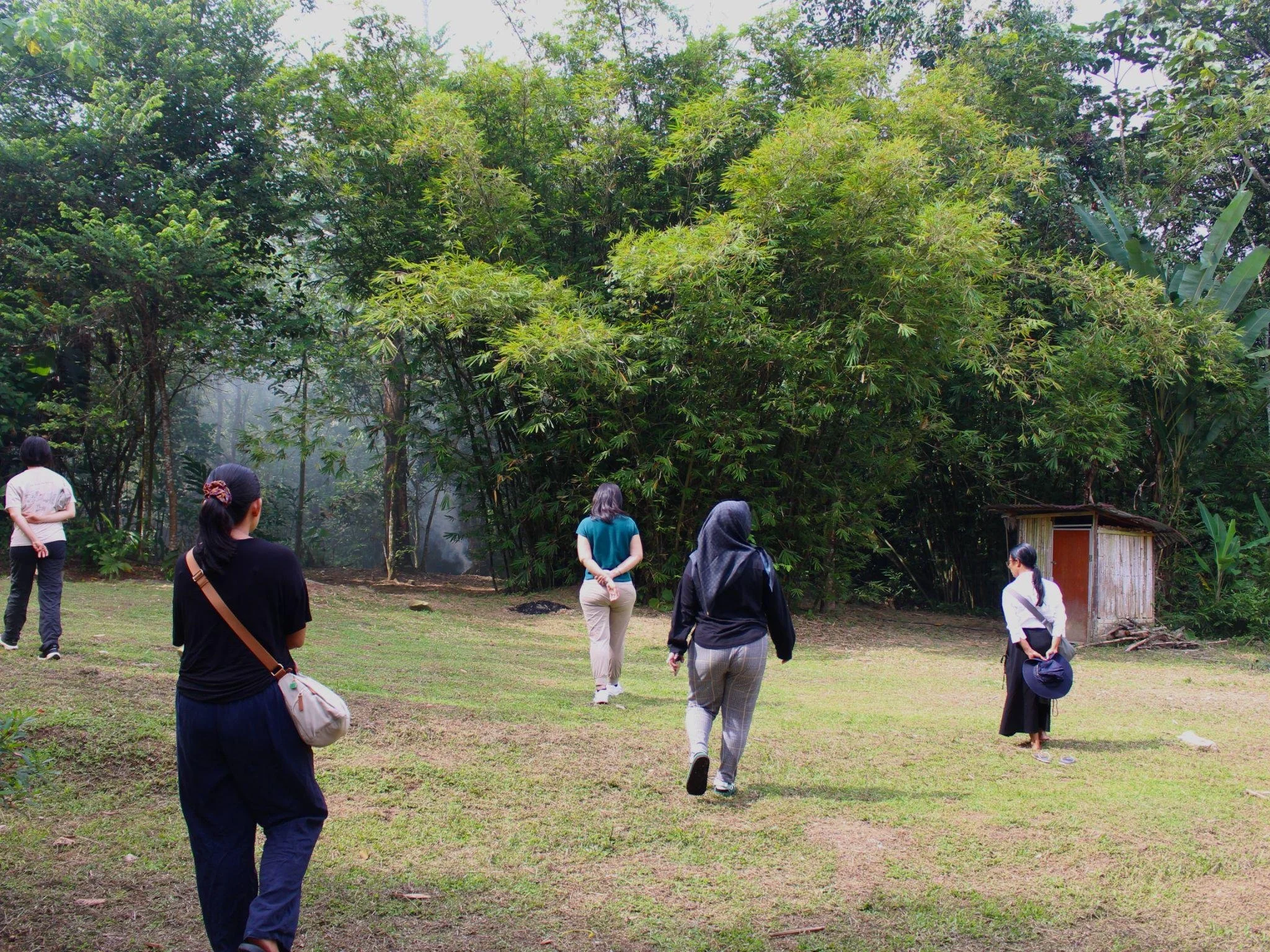
We were welcomed by Roslan, the community leader of the village, whose warmth and passion was evident. We were then invited to wander around the clearing by ourselves. Before immersing ourselves in a world of human speech and dialogue, we were given a somatic experience of the land we were on. One quality stood out for me. It was an uncultivated sense of peace, of simple co-existence, almost as if the forest had willingly withdrawn to create this space for us humans to gather in. I felt the gratitude of one who had been welcomed by the more-than-human world.
When we re-convened, Farrah from Native Allies did a beautiful job of facilitating a circle of sharing. After taking some time to introduce ourselves in a big circle, we broke up into smaller groups for discussions that were guided by two framing questions:
What do you give without being asked?
What does your community protect that has no market value?
These questions are at the heart of Indigenous values, and we had a rich conversation with our newfound Orang Asli friends. Many of them were part of the Native Fellowship, a new program which seeks to provide mentorship, capacity building, and resources for Orang Asli community leaders.
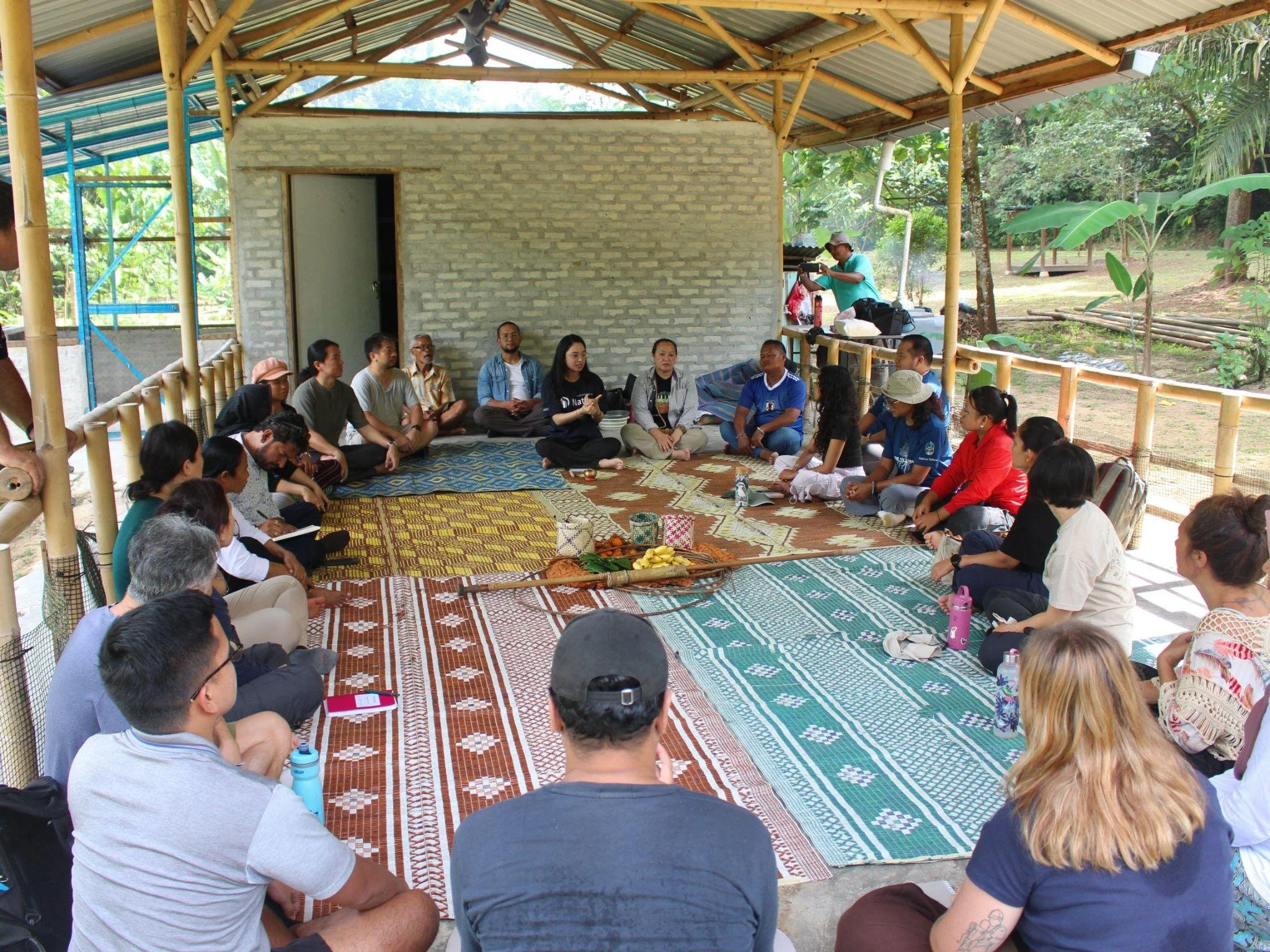
It was inspiring to see the Native Fellows speak with clarity of purpose, pride in their heritage, and a desire to be witnessed in their struggles. Like Indigenous peoples elsewhere, they are intimately connected to their land. The forest is their school. The safest person to be in the forest with is an Orang Asli. They are trained from young not to get lost, to know what plants are edible, and to be able to hunt for game. Without being asked, they continuously offer gratitude for all that the earth, sky, trees, birds, worms, rivers, fish and a multitude of other creatures give.
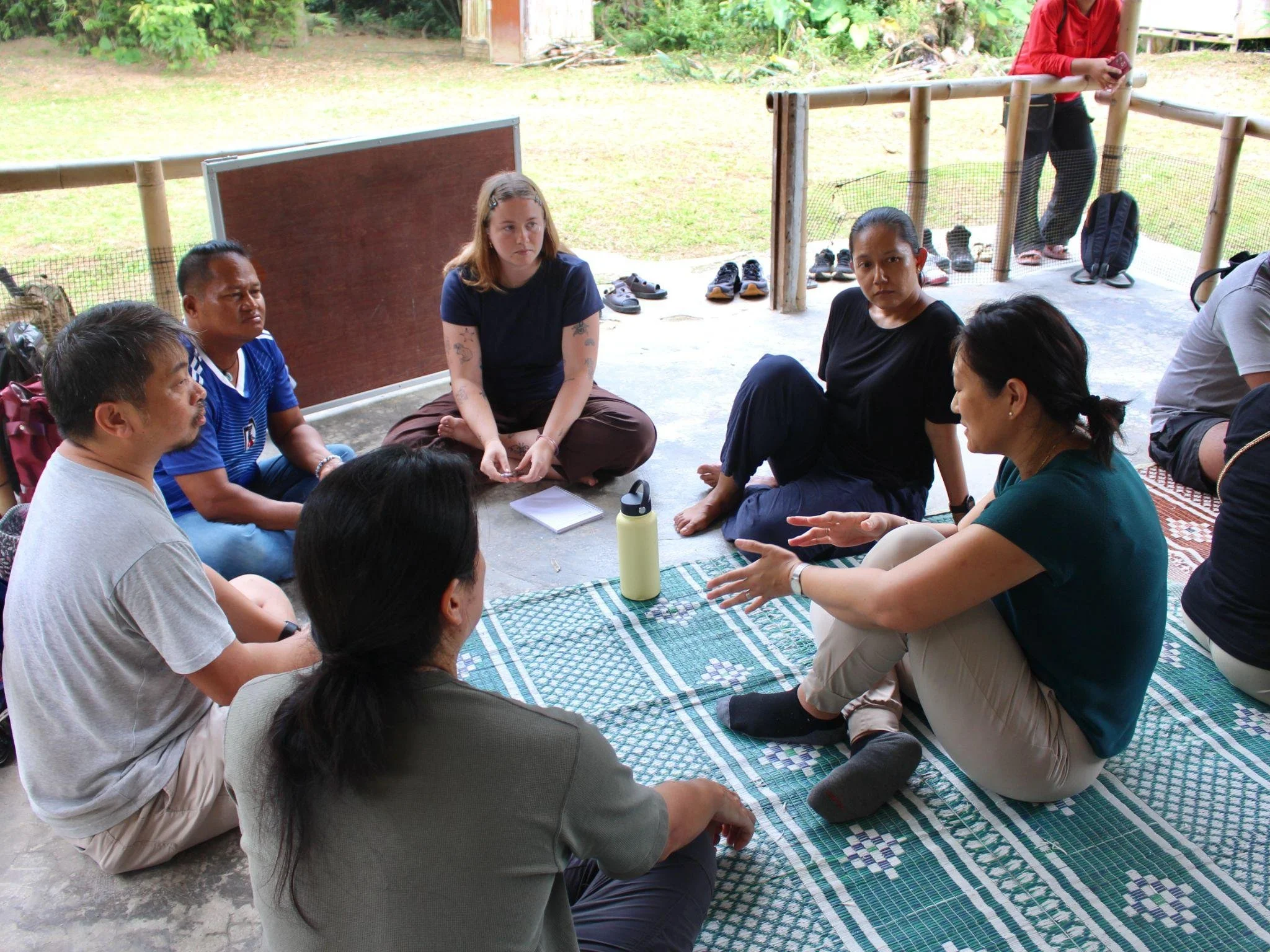
Their communities protect these ways of being and knowing. But their tenure on the land is fragile, and is constantly being threatened by mainstream society's vision of progress.
The Myth of Technological Progress
There is a terrible myth which grips most modern humans. And that is the myth of progress, especially technological progress. The core of this myth is the belief that human history has been one of linear progress, with the superiority of industrial civilisation underpinned by advanced technology. Even those civilisations that hope to become future superpowers, such as China or India, plan to do so by developing superior technology.
We equate technology with higher value; the more the better. How could we not? Even now, I'm typing this on a 2022 Macbook Air, a model that didn't exist five years ago. You will be reading this on a similar device, transmitted to you through the magic of Internet broadband. We can hardly conceive of existence without these enabling technologies.
And yet ... and yet ... Indigenous peoples confront us with an unsettling prospect. After all, one thing we know for a fact is that Indigenous peoples have survived for tens of thousands of years with what we derogatively regard as "primitive" tools. Perhaps they've been able to do so precisely because they were using tools that were people-centered and convivial.
The San people of the Kalahari desert have maintained a continuous culture for at least 20,000 to 44,000 years. Their main tool is the poisioned bow and arrow.
The Aboriginal peoples of Australia are quite possibly the oldest human culture still in existence, dating back more than 60,000 years. Their main tools are the boomerang, the hunting spear and the digging stick.
The Orang Asli have been around for at least 5,000 years. They still use the blowpipe regularly as their main hunting tool.
At this point, it is doubtful whether modern industrial civilisation might last another few hundred years, which would put its lifespan at around 500 years. As only one indicator of this terminal reality, most experts predict that we will have completely depleted our food-growing topsoil within the next 60 years unless we switch away from industrial agriculture.
In the 1970s, EF Schumacher promoted the idea of intermediate or appropriate technology. Before that, Gandhi made "village technology" the center piece of his social movement. Both men saw the need to extricate ourselves from our fetishistic, and ultimately suicidal, attachment to novel and highly-specialised technology.
The current enthusiasm for AI technology is the latest manifestation of the myth of technological progress. And it may be the one that finally destroys us. One obvious consequence of AI is that it accelerates all the extractive processes that already govern our lives. It is as if we had built an even bigger straw to suck up the Earth's resources, at a time when we are already exceeding the Earth's carrying capacity.
The contrast with the Orang Asli blowpipe couldn't be more stark. The blowpipe doesn't consume a lot of energy or resources to operate. It serves an essential function - providing food. It does so at a rate that doesn't exhaust the supply.
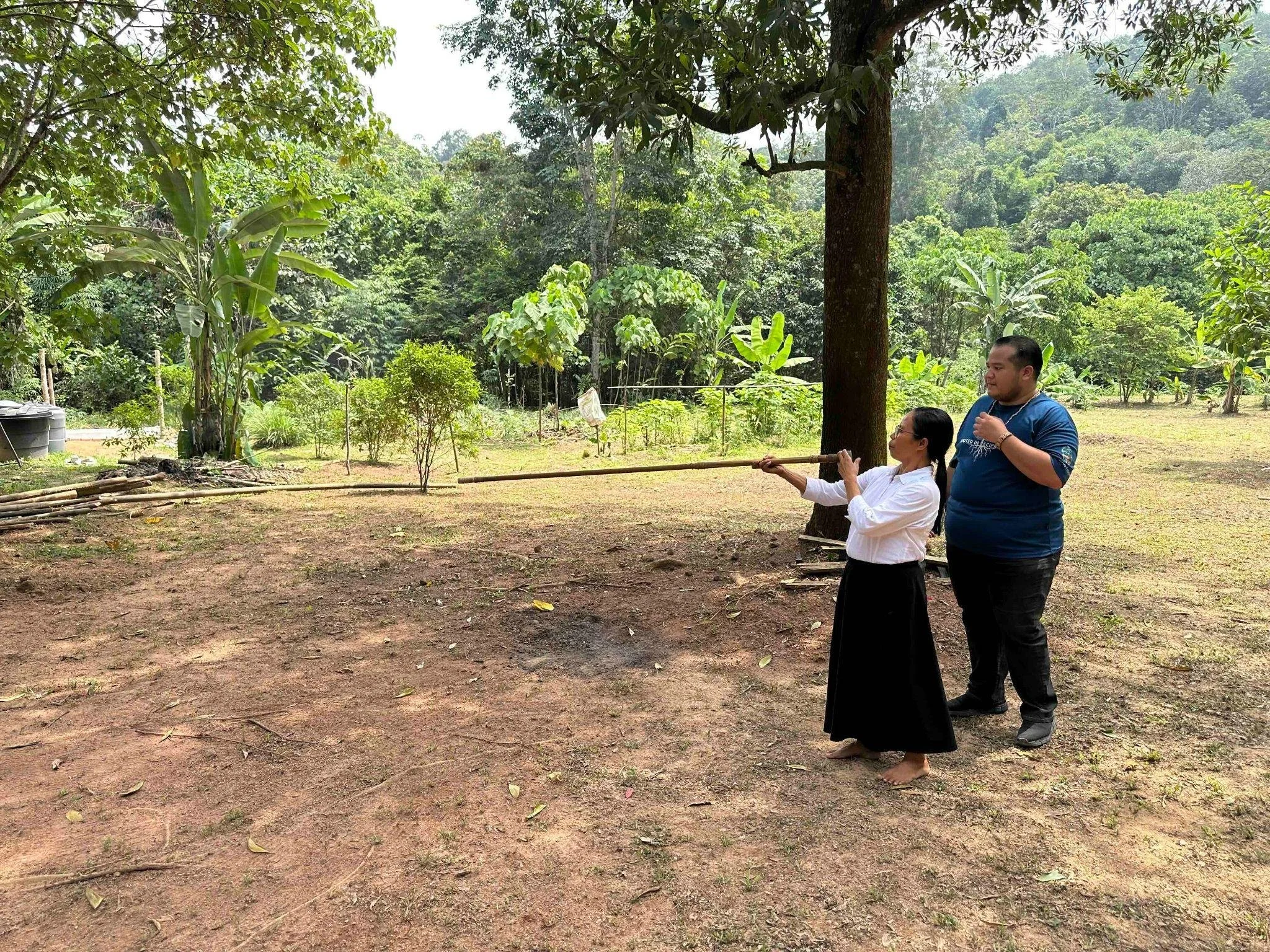
One of the activities that our Orang Asli hosts offered us was a session with a blowpipe. After they demonstrated how to use one, we took turns trying to pop some balloons that were strung up between two trees. Even though the balloons were only 5-10 metres away, it was a difficult task, and most of us didn't succeed. Instead of the satisfying sound of a balloon popping, the only thing we'd see floating through the air was the scrap of tissue paper that was used to seal the dart into the mouthpiece. While we might be tempted to think of the blowpipe as an anachronistic curiosity, I think it is a precious and important signpost towards different choices we might start making about the kinds of technology we stake our lives on.
Malaysia has ambitions to become Southeast Asia's dominant data centre hub, hoping to host two-thirds of Southeast Asia's data capacity. The energy and resource consumption of its data centers will be massive. One must ask - who profits from these technologies? And what would their answers be to these questions?
What do you give without being asked?
What does your community protect that has no market value?